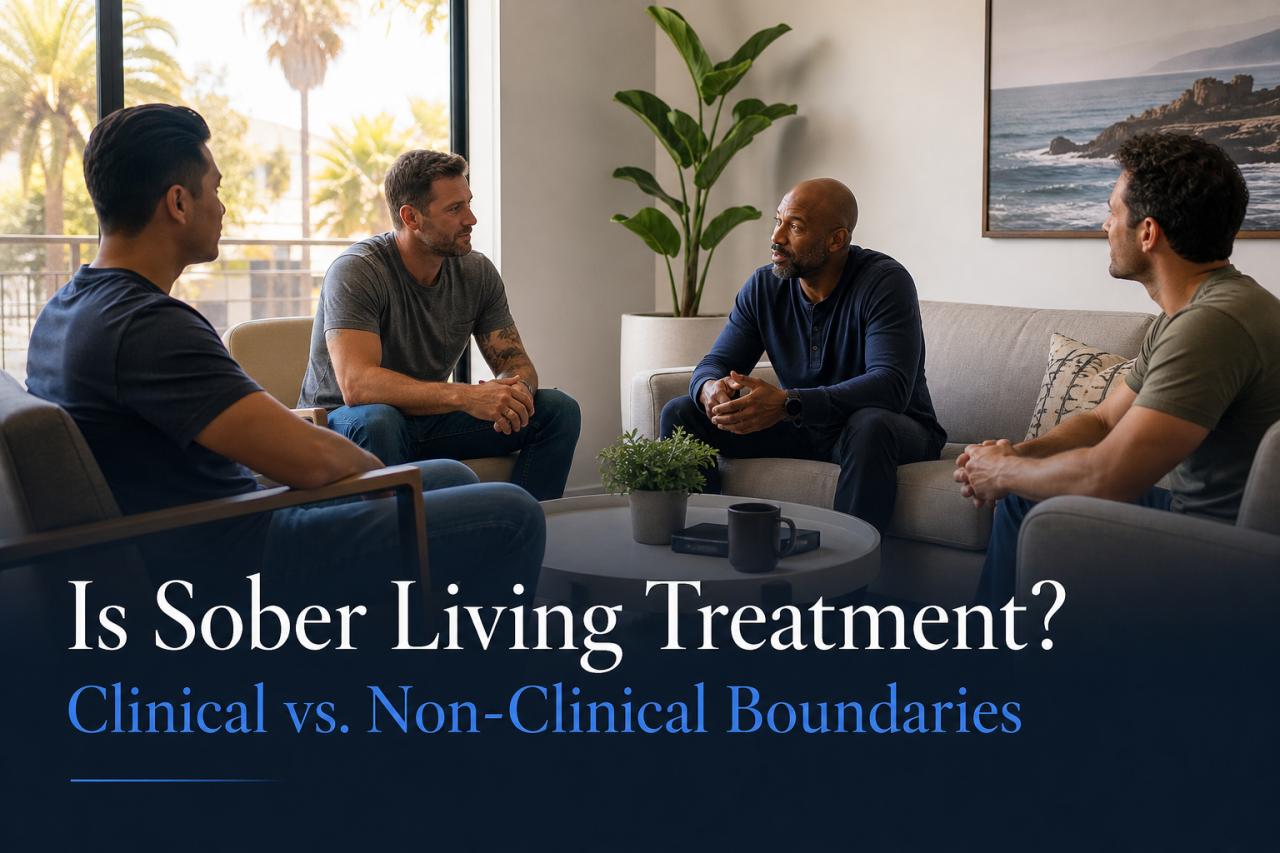
No, sober living isn't treatment in the clinical sense. It's a structured recovery residence where you live with accountability, house rules, and peer support while you do the work of early recovery. Therapy, medical care, and detox happen outside the home, with licensed providers. At CA Sober Living in Orange County, our homes are built to sit between that clinical care and independent life.
Sober living as treatment: what it covers and what it doesn't
Sober living covers housing, daily structure, and accountability, and that's where its job ends. Treatment, in the clinical sense, means a licensed provider diagnoses, prescribes, or delivers therapy. Our staff roles are built around running a home, so you won't find a therapist's office or a medical unit on the property.
What you do get is the stability that makes outside treatment easier to keep up with. A residence like ours sets a daily schedule and expects 12-step meeting attendance, which the services page lists as mandatory in the early programs. Random drug and alcohol testing is part of the routine, and peer group meetings give you people who understand what you're going through. Wellness activities such as yoga, meditation, and beach walks fill some of the hours that used to go to using.
The line gets blurry in our Post Detox program, so here's how it breaks down. Staff are trained to recognize post-acute withdrawal symptoms (PAWS) and can provide support and referrals. A Medical Liaison coordinates with your healthcare providers and supports medication management. That means the Liaison helps keep your care organized and moving, while your doctors make the medical decisions. If something needs urgent attention, staff can facilitate emergency care.
Our homes also don't replace the clinical step before them. The Post Detox program is meant for people who have recently completed detox and have medical clearance. If you haven't been through detox yet, that comes first, with a medical provider.
Families often ask who is actually in the house with their loved one. The care team is made up of a House Manager, a Medical Liaison, a Peer Support Specialist, and a Case Manager. Each role keeps the household running, connects residents to outside care, or offers peer support. None of them stands in for a licensed clinician.
The rules and daily structure you'll live with
Expect the rules to loosen as you move through the four programs, and expect them to be firmest at the start. Post Detox has the most structure, then Sober Living, then Supportive Living, and Transitional Living has the least. Each phase gives you a bit more personal freedom, which is how you practice running your own life before you're fully on your own.
In the early phases, the daily rhythm is built around a set schedule and routines, mandatory 12-step meetings, and random drug and alcohol testing. Peer group meetings fill in the rest of the week. You'll also be expected to take part in the house itself, which means respecting the people living there and the staff who run it.
Work is part of the picture too. Our services page lists employment requirements for both Post Detox and Sober Living, and they differ between the two. Ask the admissions team what applies to your starting program before you move in, so you can plan around your job or your remote work. We built the homes for people who want to keep up professional commitments, and some residents need a dedicated workspace to do that.
Ask for the specifics on a few things up front:
- 1The current length of stay for the program you'd enter.
- 2The employment requirement for that phase.
- 3How often testing and meetings happen.
- 4What changes when you move to the next phase.
Admissions can answer each of these directly, and the answers sometimes change, so it's better to hear them from our team than to rely on a secondhand number.
If you're unsure which program fits, you don't have to guess. The admissions team can help work out the right starting point based on where you are now, whether that's fresh out of detox or already months into recovery.
How outside clinical care fits around your housing
Your therapist, psychiatrist, and outpatient program stay where they are, and your schedule at home bends around their appointments. Most people arrive with some clinical care already in place, often from the treatment center they just left. If you don't have a provider yet, the Case Manager on our team is the person to ask, because connecting residents to outside care is part of that role.
Plan on a simple division of labor. Your clinicians handle diagnosis, therapy, and prescriptions. We handle the place you come home to, including the routine that gets you to appointments on time and the accountability that tells you when something's slipping. Because the Medical Liaison coordinates with your healthcare providers, your doctors and the house don't operate as separate worlds.
Outpatient programs such as PHP (partial hospitalization) and IOP (intensive outpatient) are a common pairing with sober living. They run during the day, and you return to the house in the evening. If you're weighing that setup, ask admissions how a day program would fit with the house schedule and your work requirements, so nothing collides in your first week.
A few things are worth having ready when you talk with us:
- 1The name and contact information of your current providers, if you have them.
- 2Your medication list, since the Medical Liaison supports medication management.
- 3Any discharge or aftercare plan from your treatment program.
- 4Your appointment times, so we can plan around them.
If a medical or mental health concern comes up that the house can't address, staff can offer referrals and, in an emergency, facilitate emergency care. Your outside providers stay in charge of treatment decisions. We keep you housed, structured, and connected to them.
What drives the cost of sober living in Orange County
The price of a bed depends mostly on which program you enter, what the house includes, and how long you stay. We don't publish a rate sheet, because the numbers differ by program and can change, so the admissions team gives you current pricing when you call.
Program phase is the biggest variable. Post Detox carries the most structure and staff involvement, and Transitional Living carries the least, so the cost of each phase reflects how much support the house provides. Length of stay matters just as much. Because stays differ by program, a monthly figure only tells you part of the story until you know how many months you're likely to be there.
The home itself also shapes the price. Our homes have a coastal-inspired design and a nutrition-focused gourmet kitchen, and some residents need a dedicated workspace for remote jobs. Those are features of a premium residential setting, and they cost more to run than a bare-bones house. If a lower-cost option fits you better, say so on the call, and admissions can talk through what you'd be trading.
Costs outside the house are easy to overlook. Outpatient care such as PHP or IOP, therapy, and prescriptions are billed by those providers, separate from your housing. Sober living is a residence, not a clinical service, so don't assume your health insurance will pay for a bed the way it might for a treatment program. Ask your insurer directly about what it covers, and ask your outside providers for their own fees.
Before you commit, ask admissions to put these in writing:
The current rate for your starting program.
What the rate includes, such as meals and testing.
The expected length of stay for that phase.
Any move-in or other one-time charges.
How the cost changes when you move to the next phase.
Getting those five answers lets you compare our homes against any other residence on equal terms.
Choosing a program and what happens when you call
Most people start in one of two places: Post Detox if they finished medical detox recently and have clearance, or Sober Living if they've already stabilized and want structure with growing freedom. Supportive Living and Transitional Living usually come later, after you've built some time and routine in an earlier phase. If you can't tell where you fit, you don't need to decide before you call. Working out the starting point is part of what admissions does.
The call is a conversation, not a screening you have to pass. Someone on the admissions team will ask where you are in recovery right now, whether you've just left detox or inpatient treatment, what outside care you have lined up, and what your work situation looks like. They'll use those answers to point you toward a program and explain how that phase runs, including the rules, testing, meeting expectations, and employment requirement we covered above.
You can ask your own questions too. The five items on the pricing list are fair game, and so are the program's current length of stay and what the move to the next phase involves. If a family member is calling for you, that works fine. Expect the team to want to hear from the person who'd be living in the house before a move-in is set.
After the call, the next steps usually follow in a familiar order:
Share your provider details and any discharge or aftercare plan.
Confirm the program, the written rate, and what it includes.
Line up your appointments and work schedule around house routines.
Settle on a move-in plan with the team.
If you're unsure about a house after hearing all that, say so. A home that matches your recovery stage and your daily obligations will be easier to stay in than one that sounded good on paper.
To talk with our admissions team about the right starting point, call us at (949) 801-5645 or reach out through our contact page.